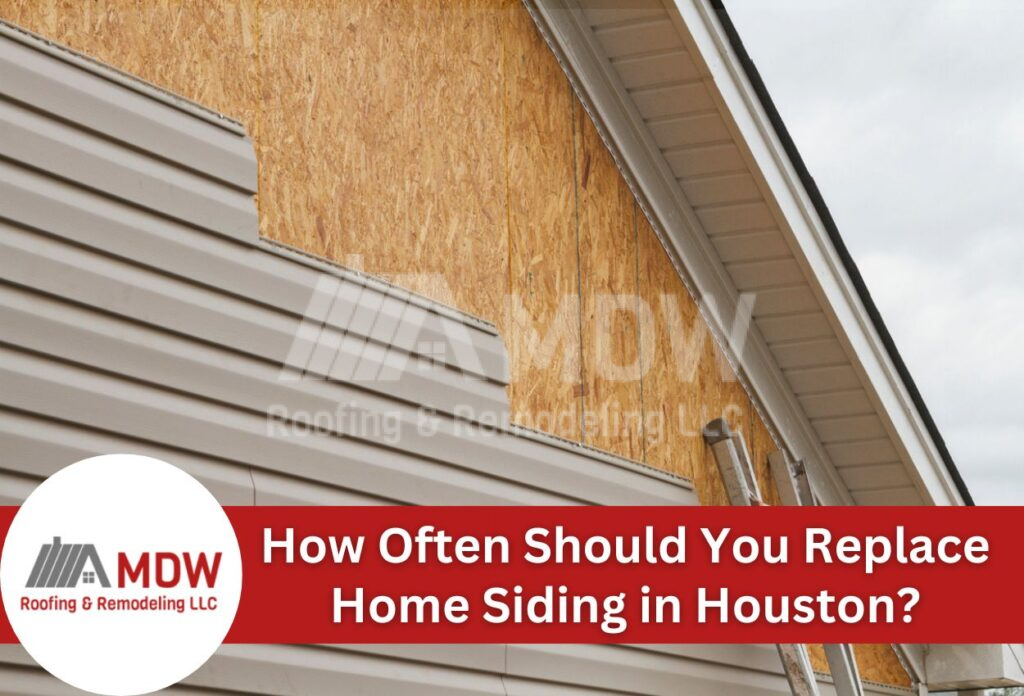
Siding replacement in Houston depends on material type, installation quality, and maintenance diligence—vinyl siding averages 20-40 year lifespan in Houston’s climate, fiber cement achieves 30-50 years, wood siding requires replacement after 15-40 years depending on species and maintenance intensity, aluminum lasts 25-40 years, and engineered wood products provide 20-30 year service lives before deterioration necessitates replacement. Houston’s subtropical climate featuring 95°F+ temperatures exceeding 100 days annually, 70-90% humidity promoting biological growth, 53 inches annual rainfall testing waterproofing integrity, intense UV radiation degrading surface finishes, and periodic hurricane-force winds (130+ mph during major storms) stressing mechanical attachments accelerates siding deterioration 20-30% faster than moderate climates—materials rated 40-50 year lifespans nationally often require replacement at 30-35 years locally when exposed to Houston’s environmental extremes.
Replacement timing indicators include visible damage (cracking, warping, rot, holes from impact or insect activity), performance degradation (increasing energy bills from compromised insulation, moisture intrusion causing interior mold growth, fading or chalking revealing UV protection failure), structural concerns (loose panels indicating fastener failure, bubbling or blistering showing trapped moisture, separation at seams or corners creating water entry points), and maintenance burden escalation (frequent repairs exceeding $500-$1,000 annually suggesting systemic failure, paint requiring refreshing every 3-5 years versus manufacturer-specified 10-15 year intervals).
Proactive replacement before catastrophic failure—typically when siding reaches 75-85% of expected lifespan or when repair costs exceed 30-40% of replacement expense—prevents water infiltration damaging wall framing, insulation, and interior finishes (totaling $5,000-$15,000+ remediation costs) while allowing orderly contractor selection and scheduling avoiding emergency premiums and extended property exposure inherent in reactive crisis response. This comprehensive guide examines Houston-specific siding lifespan expectations by material, damage recognition criteria, maintenance protocols maximizing service life, repair versus replacement decision frameworks, and contractor selection guidance ensuring quality installations meeting manufacturer specifications while delivering expected durability in Houston’s challenging climate.
Understanding Siding Lifespan in Houston’s Climate
Houston’s subtropical humid climate (Köppen classification Cfa) creates demanding siding conditions combining intense solar radiation, high moisture exposure, severe weather events, and biological growth pressures requiring materials demonstrating comprehensive durability rather than single-attribute optimization common in moderate climate regions.
Houston climate siding stressors:
| Climate Factor | Houston Characteristics | Siding Impact | Lifespan Reduction |
|---|---|---|---|
| Solar radiation | 95°F+ temperatures 100+ days, 1,600-1,800 annual sunshine hours | UV degradation of surface finishes, thermal expansion/contraction stress | 15-20% faster fading, chalking, brittleness versus moderate climates |
| Thermal cycling | 30-40°F daily temperature swings, 20-100°F seasonal range | Material expansion/contraction fatiguing fasteners and joints | Fastener loosening 20-30% more frequent than northern climates |
| Humidity exposure | 70-90% relative humidity year-round | Moisture penetration through micro-cracks, biological growth on surfaces | Wood rot 2-3× faster; mold growth requiring cleaning every 1-2 years |
| Heavy rainfall | 53 inches annual average, 4-8 inch intensity storms | Water infiltration testing seam integrity, saturating porous materials | Vulnerable materials (wood, engineered wood) deteriorate 25-35% faster |
| Hurricane winds | 130+ mph sustained during major storms | Impact damage from flying debris, fastener pullout from wind pressure | Storm damage events every 3-7 years typical for coastal Harris County |
| UV degradation | Year-round intense sunlight exposure | Polymer breakdown, pigment fading, surface oxidation | Dark colors fade 30-50% faster than light colors in Houston sun |
The National Association of Home Builders reports material lifespans 20-30% shorter in hot humid climates compared to temperate regions, with Houston’s combination of heat, moisture, and severe weather representing particularly demanding conditions accelerating deterioration mechanisms across all siding types. Understanding these climate-specific stressors helps homeowners establish realistic replacement expectations and recognize when siding performance degradation signals approaching end of service life.
Siding Lifespan by Material Type
Different siding materials demonstrate vastly different durability characteristics in Houston’s climate, with selection decisions balancing initial cost, expected lifespan, maintenance requirements, and aesthetic preferences across materials ranging from economical vinyl to premium fiber cement and traditional wood options.
Vinyl Siding Lifespan and Performance
Vinyl siding represents Houston’s most popular residential siding choice due to moderate cost ($3-$8/sq ft installed), minimal maintenance requirements, reasonable durability (20-40 years typical), and wide color/style availability meeting diverse architectural preferences. Polyvinyl chloride (PVC) polymer formulation provides inherent moisture resistance and rot immunity advantageous in humid climates.
Vinyl siding lifespan factors:
| Quality Tier | Thickness | Warranty | Houston Lifespan | Installed Cost | Performance Notes |
|---|---|---|---|---|---|
| Budget grade | 0.040-0.042 inch | 20-30 years | 15-25 years | $3-$5/sq ft | Prone to warping in extreme heat, fading in 10-15 years, cracking from impact |
| Standard grade | 0.044-0.046 inch | 30-40 years | 20-30 years | $5-$7/sq ft | Adequate UV resistance, moderate fade resistance, acceptable impact strength |
| Premium grade | 0.048-0.050+ inch | 40-50 years (lifetime transferable) | 30-40 years | $7-$10/sq ft | Enhanced UV stabilizers, superior fade resistance, improved impact resistance |
Vinyl siding advantages in Houston:
- Inherent moisture resistance prevents rot, peeling, or flaking common with painted wood
- Minimal maintenance requiring only periodic washing with soap and water
- Resistant to insect damage (termites, carpenter ants) prevalent in humid Gulf Coast region
- No painting required maintaining original factory finish throughout lifespan
- Cost-effective initial installation 30-50% less expensive than fiber cement or wood alternatives
Vinyl siding vulnerabilities:
- Heat susceptibility causing warping or distortion when temperatures exceed 160-180°F (dark colors on southwest exposures particularly vulnerable)
- UV degradation causing fading, chalking, or brittleness after 15-25 years depending on quality
- Impact damage from hail, flying debris, or physical contact creating cracks or holes
- Expansion/contraction movement requiring proper installation clearances avoiding buckling
- Limited repair options for damaged sections often requiring full panel replacement
Premium-grade vinyl with enhanced UV stabilizers and impact resistance justifies cost premium in Houston’s demanding climate, extending functional lifespan from typical 20-25 years (budget grades) to 30-40 years while maintaining appearance and structural integrity throughout extended service period.
Fiber Cement Siding Longevity
Fiber cement siding—composed of cement, sand, and cellulose fibers formed into boards or panels—represents premium siding choice offering superior durability (30-50+ years typical in Houston), excellent fire resistance, and dimensional stability in varying weather conditions. James Hardie and other manufacturers provide products specifically engineered for hot humid climates like Houston’s Gulf Coast region.
Fiber cement performance characteristics:
- Lifespan expectation – 30-50+ years in Houston climate with proper maintenance (paint refreshing every 10-15 years)
- Moisture resistance – Non-organic composition prevents rot, warping, or swelling from moisture exposure
- Fire rating – Non-combustible material providing Class A fire resistance improving insurance rates
- Impact resistance – Dense composition resists hail damage, flying debris, and physical impacts better than vinyl or wood
- Insect immunity – Inorganic material prevents termite, carpenter ant, or carpenter bee damage
- Dimensional stability – Minimal expansion/contraction versus vinyl or wood maintaining joint integrity
Installed cost considerations:
| Product Type | Installed Cost | Maintenance Frequency | Total 30-Year Cost | Annualized Cost |
|---|---|---|---|---|
| Fiber cement | $8-$14/sq ft | Paint every 12-15 years ($2-$4/sq ft) | $10-$18/sq ft | $333-$600/sq ft/year |
| Premium vinyl | $7-$10/sq ft | Wash annually (DIY) | $7-$10/sq ft | $233-$333/sq ft/year |
| Wood (cedar) | $10-$15/sq ft | Paint/stain every 5-7 years ($3-$5/sq ft) | $16-$25/sq ft | $533-$833/sq ft/year |
Fiber cement justifies 40-75% cost premium over vinyl through extended 50% longer lifespan, superior weather resistance minimizing repair frequency, and maintained appearance with proper painting cycles—total 30-year ownership costs comparable to premium vinyl when accounting for longevity differences and maintenance requirements.
Wood Siding Durability and Maintenance
Wood siding offers unmatched natural aesthetic appeal and traditional architectural character but demands intensive maintenance preventing moisture-related deterioration particularly challenging in Houston’s humid climate. Cedar, redwood, and cypress species provide natural rot resistance superior to pine or fir alternatives.
Wood siding lifespan expectations:
- Cedar/redwood (maintained) – 30-40 years with religious paint/stain maintenance every 4-6 years and prompt repair of damage
- Cedar/redwood (poorly maintained) – 15-20 years before rot, warping, or insect damage necessitates replacement
- Pine/fir (maintained) – 20-30 years requiring even more frequent finishing and vigilant moisture monitoring
- Pine/fir (poorly maintained) – 10-15 years before widespread deterioration demands replacement
Wood siding maintenance requirements:
- Paint or stain application every 4-6 years ($3-$5/sq ft professional application) maintaining moisture barrier
- Annual inspection for rot, insect damage, or paint failure requiring spot repairs
- Caulking refreshment at joints, corners, and trim interfaces every 2-3 years
- Periodic cleaning removing mold, mildew, or algae growth particularly prevalent in Houston humidity
- Prompt repair of damaged boards preventing moisture infiltration accelerating adjacent board deterioration
Houston’s 70-90% humidity and 53 inches annual rainfall create particularly challenging wood siding environment—moisture trapped behind paint films causes blistering, peeling, and eventual rot despite best maintenance efforts. Homeowners selecting wood siding must commit to intensive ongoing maintenance or accept dramatically reduced 15-20 year lifespans before replacement becomes necessary.
Alternative Siding Materials
Additional siding options serve specific applications or architectural styles, each offering distinct performance characteristics and lifespan expectations in Houston’s climate.
Alternative material performance:
| Material | Typical Lifespan (Houston) | Installed Cost | Key Advantages | Primary Limitations |
|---|---|---|---|---|
| Aluminum | 25-40 years | $5-$9/sq ft | Corrosion resistant, lightweight, fire resistant | Dents easily, limited color options, fades over time |
| Engineered wood | 20-30 years | $6-$10/sq ft | Natural wood appearance, improved moisture resistance vs solid wood | Still vulnerable to moisture, requires painting, moderate lifespan |
| Brick veneer | 50-100+ years | $12-$20/sq ft | Exceptional durability, minimal maintenance, fire resistant | Very expensive, limited retrofit applications |
| Stone veneer | 50-75+ years | $15-$30/sq ft | Premium appearance, excellent durability | Highest cost, installation complexity, weight concerns |
| Stucco | 50-80 years | $6-$12/sq ft | Seamless appearance, excellent durability | Crack prone, difficult repairs, moisture management critical |
Material selection balances initial budget, expected residence duration, maintenance tolerance, and aesthetic preferences—vinyl provides best value for cost-conscious homeowners planning 15-30 year residence duration, fiber cement justifies premium for long-term ownership (30+ years) or high-end property repositioning, while wood suits traditional architecture enthusiasts accepting intensive maintenance obligations.
Recognizing Siding Replacement Indicators
Understanding when siding transitions from serviceable condition requiring routine maintenance to deteriorated state necessitating replacement prevents progressive damage escalation creating expensive secondary problems including wall framing rot, insulation saturation, interior mold growth, and structural compromise.
Visual Damage Signs
External inspection reveals obvious damage symptoms indicating siding approaching or exceeding functional lifespan requiring professional assessment determining repair sufficiency versus replacement necessity.
Critical visual indicators:
- Cracking – Fractures through siding panels compromising waterproofing integrity; isolated cracks often repairable, widespread cracking (>20% of panels) suggests systemic material failure
- Warping – Panels bowing, buckling, or pulling away from wall surface typically from heat exposure (vinyl), moisture (wood), or improper installation; warped sections create water entry points requiring replacement
- Rot – Soft, spongy, or discolored areas on wood or engineered wood siding indicating moisture penetration and biological degradation; any rot requires immediate board replacement preventing spread
- Holes – Perforations from impact damage, insect activity, or material deterioration allowing direct water infiltration; even small holes warrant prompt repair before interior damage develops
- Fading – Significant color loss indicating UV protection degradation; while primarily cosmetic, severe fading often accompanies material brittleness increasing crack susceptibility
- Chalking – Powdery surface residue wiping off on hands revealing surface oxidation and protective coating breakdown; advanced chalking signals approaching material failure
- Bubbling/blistering – Raised areas on painted siding showing moisture trapped beneath surface; indicates water infiltration requiring investigation and repair
Isolated damage affecting <10% of siding area typically merits repair rather than complete replacement, though damage patterns suggesting systemic issues (widespread cracking, multiple rot locations, extensive fading across entire elevations) indicate replacement providing better long-term value than incremental repairs postponing inevitable comprehensive renovation.
Performance Degradation Symptoms
Beyond visible damage, functional performance decline signals siding no longer adequately protecting building envelope requiring investigation and potential replacement restoring proper building performance.
Performance problem indicators:
- Increased energy bills – Rising heating/cooling costs despite stable usage patterns suggesting compromised insulation from air leakage through damaged siding or moisture-saturated wall cavities
- Interior moisture problems – Water stains on interior walls, ceiling discoloration near exterior walls, or musty odors indicating exterior moisture penetration through failed siding
- Mold growth – Black, green, or white patches on interior walls near exterior surfaces revealing persistent moisture infiltration creating health hazards and structural damage
- Peeling interior paint – Bubbling or flaking paint on interior walls adjacent to exterior surfaces demonstrating moisture migrating through wall assembly
- Loose or rattling panels – Siding sections moving in wind or easily pushed away from wall indicating fastener failure or material deterioration requiring reattachment or replacement
- Seam separation – Gaps opening at panel joints, corners, or trim interfaces allowing water entry; minor separations often caulk-repairable, extensive gaps indicate replacement necessity
The Building Performance Institute emphasizes that siding performance extends beyond aesthetics to critical building envelope functions including moisture management, thermal performance, and structural protection—performance degradation symptoms warrant prompt professional assessment preventing minor problems escalating into major building system failures requiring $10,000-$30,000+ remediation.
Maintenance Strategies Maximizing Siding Lifespan
Proactive maintenance protocols extend siding functional lifespan 20-40% beyond typical expectations through early problem detection, prompt minor repairs, and preventive measures addressing deterioration mechanisms before damage becomes irreversible or widespread.
Routine Inspection and Cleaning Schedule
Regular inspection identifies developing problems when repairs remain minor and inexpensive versus reactive replacement approaches costing 5-10× more after damage progresses to failure. Houston’s demanding climate justifies semi-annual inspections timed around seasonal weather extremes.
Recommended maintenance timeline:
| Maintenance Task | Frequency | DIY Cost | Professional Cost | Houston Climate Rationale |
|---|---|---|---|---|
| Visual inspection | Semi-annual (April, October) | $0 (homeowner time) | $150-$300 if professional | Pre/post hurricane season damage assessment |
| Washing/cleaning | Annual minimum | $50-$100 (supplies/equipment rental) | $300-$600 | Remove mold, mildew, pollution preventing biological growth |
| Caulk inspection/refresh | Every 2-3 years | $25-$50 (materials) | $300-$600 | Seal joints preventing moisture infiltration through thermal movement gaps |
| Paint/stain (wood siding) | Every 4-7 years | $500-$1,500 (DIY materials) | $2,500-$6,000 | Maintain moisture barrier preventing wood rot |
| Minor repairs | As discovered | $25-$200 per repair | $150-$500 per repair | Prompt attention prevents isolated damage spreading |
| Professional assessment | Every 5 years or after major storms | N/A | $200-$400 | Identify hidden problems, verify continuing adequacy |
Semi-annual homeowner inspections focusing on ground-level accessible areas combined with comprehensive professional assessment every 5 years identifies 90%+ of developing problems when correction costs remain manageable ($100-$500 typical) versus waiting until obvious failures force reactive replacement ($15,000-$35,000+ typical residential siding replacement).
Material-Specific Maintenance Requirements
Different siding materials demand tailored maintenance approaches addressing their unique vulnerabilities and deterioration mechanisms—maintenance protocols effective for vinyl prove inadequate or inappropriate for wood or fiber cement alternatives.
Vinyl siding maintenance:
- Annual washing with soap and water removing dirt, mold, mildew accumulation
- Inspection for cracks, warping, or loose panels requiring individual panel replacement
- Caulk refreshment at joints and interfaces maintaining waterproof seals
- Tree trimming preventing branch contact that damages panels or traps moisture
- Avoid pressure washing >1,500 PSI that forces water behind panels or damages surface
Fiber cement siding maintenance:
- Paint refreshing every 10-15 years maintaining factory finish and moisture protection
- Caulk inspection/replacement every 3-5 years preventing moisture infiltration at joints
- Trim contact repair where ground contact or splashback damages bottom edges
- Fastener inspection ensuring secure attachment preventing panel movement
- Prompt repair of cracks or chips preventing moisture penetration and progressive damage
Wood siding maintenance:
- Paint or stain application every 4-6 years maintaining moisture barrier integrity
- Annual inspection for rot, particularly at horizontal surfaces collecting water
- Immediate repair of damaged boards preventing moisture infiltration to adjacent areas
- Caulking maintenance at all joints, trim interfaces, and penetrations
- Treatment for insect damage (termites, carpenter ants, carpenter bees) common in Houston
- Vegetation clearance preventing moisture trapping and biological growth
Adhering to manufacturer-specified maintenance protocols protects warranty coverage while maximizing material lifespan—neglected siding often fails at 50-60% of expected service life while properly maintained installations regularly exceed manufacturer predictions by 20-30%.
Repair Versus Replacement Decision Framework
Determining whether damaged or deteriorating siding warrants repair or complete replacement requires evaluating damage extent, remaining lifespan, repair costs versus replacement expenses, and property ownership timeframe—structured decision frameworks prevent premature replacement while avoiding ongoing repair expenses approaching or exceeding replacement costs.
Damage Assessment and Repair Thresholds
Quantifying damage extent and distribution informs repair versus replacement decisions, with localized damage generally favoring repair while widespread deterioration indicates replacement providing better value.
Repair/replacement decision matrix:
| Damage Extent | Typical Scenario | Recommended Action | Cost Comparison | Rationale |
|---|---|---|---|---|
| <10% affected area | Isolated storm damage, localized rot, few cracked panels | Repair damaged sections | Repair: $500-$2,000; Replacement: $15,000-$35,000 | Repair costs 5-10% of replacement |
| 10-30% affected area | Multiple problem areas, scattered deterioration, several elevations damaged | Evaluate age and condition; repair if <50% expected lifespan | Repair: $2,000-$7,000; Replacement: $15,000-$35,000 | Decision depends on remaining lifespan |
| 30-50% affected area | Extensive damage, multiple elevations compromised, systemic problems | Replace if >60% expected lifespan; consider full replacement | Repair: $7,000-$15,000; Replacement: $15,000-$35,000 | Repair costs approach replacement |
| >50% affected area | Widespread failure, multiple material types failing, structural concerns | Full replacement recommended | Repair: $10,000-$20,000; Replacement: $15,000-$35,000 | Replacement often cheaper than extensive repair |
The “30% rule” suggests when repair costs exceed 30% of replacement expense or when damage affects 30%+ of total siding area, replacement typically provides superior long-term value through comprehensive solution eliminating existing problems while resetting service life expectancy to full material lifespan.
Age and Remaining Lifespan Considerations
Siding chronological age critically influences repair versus replacement decisions—older installations approaching end of expected service life benefit minimally from repairs extending lifespan only 2-5 additional years before replacement becomes unavoidable.
Age-based decision guidance:
- <50% expected lifespan – Repair almost always appropriate unless catastrophic damage or widespread manufacturing defects
- 50-75% expected lifespan – Evaluate repair costs carefully; replacement often better value if repairs exceed 25-30% of replacement cost
- 75-90% expected lifespan – Replacement typically recommended unless repairs very minor (<$1,000) providing 3-5 year extension
- >90% expected lifespan – Replacement strongly recommended; repairs rarely economically justified
Example scenario: 25-year-old vinyl siding (premium grade, 40-year expected lifespan = 62.5% age) showing $4,000 repair needs versus $18,000 replacement cost. Repair represents 22% of replacement cost but siding has only ~15 years remaining lifespan. Analysis favors replacement providing 40-year fresh lifespan versus repairing aging system requiring additional maintenance and eventual replacement within 10-15 years.
Siding Replacement Cost Analysis
Understanding complete replacement costs—including material, labor, prep work, trim, and disposal—enables accurate budget planning and informed material selection balancing initial investment against expected lifespan and maintenance requirements.
Material and Installation Cost Breakdown
Residential siding replacement costs vary significantly based on material selection, project complexity, home size, and labor market conditions in Houston area.
Typical replacement cost ranges (1,500 sq ft home, standard complexity):
| Material | Material Cost | Labor Cost | Total Installed | Expected Lifespan | Annual Cost |
|---|---|---|---|---|---|
| Budget vinyl | $1,500-$3,000 | $4,500-$6,000 | $6,000-$9,000 | 15-25 years | $300-$600/year |
| Premium vinyl | $3,000-$5,000 | $5,000-$8,000 | $8,000-$13,000 | 30-40 years | $267-$433/year |
| Fiber cement | $4,500-$8,000 | $7,500-$12,000 | $12,000-$20,000 | 30-50 years | $300-$667/year |
| Wood (cedar) | $5,000-$10,000 | $7,500-$12,000 | $12,500-$22,000 | 20-40 years (with maintenance) | $417-$917/year |
| Engineered wood | $3,500-$6,500 | $6,000-$9,500 | $9,500-$16,000 | 20-30 years | $400-$667/year |
| Aluminum | $3,000-$6,000 | $5,500-$8,500 | $8,500-$14,500 | 25-40 years | $283-$483/year |
Annual cost analysis demonstrates premium vinyl and fiber cement providing best long-term value through optimal balance of durability, maintenance requirements, and lifespan—initial cost premiums offset by extended service lives and minimal ongoing maintenance expenses.
Additional Cost Factors
Beyond basic material and installation costs, several factors influence total project expense requiring consideration during budget planning.
Cost impact variables:
- Existing siding removal – Adds $1,000-$3,000 depending on material type, disposal fees, and complexity
- Sheathing repair – Damaged wall sheathing discovered during removal requires replacement ($2-$4/sq ft affected areas)
- Insulation upgrade – Adding house wrap, rigid foam, or spray foam insulation during replacement ($1-$3/sq ft)
- Trim replacement – Window/door trim, corners, and decorative elements often require updating ($500-$2,000)
- Paint/finish – Fiber cement, wood, or engineered wood requiring factory finish or field painting ($1-$3/sq ft)
- Accessibility challenges – Multi-story homes, complex architecture, or limited access increase labor costs 20-40%
- Permit fees – Required in most Houston-area jurisdictions ($100-$500 depending on project value)
Comprehensive replacement projects including removal, sheathing inspection/repair, insulation upgrade, and trim work typically cost 30-50% more than basic material replacement alone—budgeting should account for these likely additional expenses rather than assuming lowest quoted material cost represents total project investment.
Choosing Professional Siding Contractors
Siding replacement quality critically determines long-term performance—proper installation following manufacturer specifications ensures expected lifespan achievement while poor workmanship causes premature failures, warranty voidance, and expensive corrective work within 5-10 years.
Essential Contractor Qualifications
Selecting qualified experienced contractors ensures installation meeting manufacturer specifications and local building code requirements protecting homeowner investment and warranty coverage.
Minimum contractor requirements:
- Licensing – Valid Texas contractor license demonstrating competency and regulatory compliance
- Insurance – Minimum $1 million general liability coverage protecting property owners from installation damage claims
- Workers compensation – Coverage for all crew members protecting homeowners from injury liability
- Manufacturer certification – Training/certification from siding manufacturer being installed (particularly important for fiber cement)
- Experience – Minimum 5+ years Houston-area installation experience understanding local climate challenges
- References – Recent similar projects with verifiable satisfied customer references
- Warranty offerings – Minimum 5-year workmanship warranty covering installation defects beyond material warranties
The Better Business Bureau and Angi provide contractor directories with customer ratings, complaint histories, and detailed business information enabling informed selection from reputable professionals versus unlicensed operators or fly-by-night storm chasers offering suspiciously low pricing.
Quality Installation Verification
Homeowners should verify proper installation procedures during construction and completion ensuring work meets manufacturer specifications required for warranty coverage validity.
Critical installation checkpoints:
- Proper fastening – Correct fastener type, spacing, and penetration depth per manufacturer specs; loose or over-driven fasteners cause premature failure
- Expansion gaps – Adequate clearance allowing thermal movement without buckling (particularly critical for vinyl in Houston heat)
- Flashing installation – Proper water management at windows, doors, corners, and penetrations preventing moisture infiltration
- Overlap compliance – Correct panel overlap dimensions maintaining waterproof integrity
- Trim details – Professional corner treatments, window/door casings, and decorative elements
- House wrap installation – Proper moisture barrier installation and integration with existing building envelope
Quality contractors welcome homeowner observation and provide detailed installation photos documenting proper procedures—contractors resisting oversight or refusing to explain installation methods should be avoided regardless of cost savings offered.
Taking Action on Siding Replacement
Houston homeowners noticing siding damage, performance degradation, or installations approaching expected service life benefit from proactive replacement planning enabling contractor comparison, material evaluation, and scheduled installation avoiding emergency response necessitated by catastrophic failures during severe weather exposing building interior to elements.
Recognizing when siding transitions from serviceable condition requiring routine maintenance to deteriorated state necessitating replacement protects property value while preventing progressive damage. Visual damage indicators—cracking affecting multiple panels, warping creating water entry points, rot spreading to adjacent boards, extensive fading revealing UV protection breakdown—signal approaching replacement requirements, while performance symptoms including rising energy costs, interior moisture problems, or mold growth demonstrate siding no longer adequately protecting building envelope.
Proactive replacement timing—typically when siding reaches 75-85% of expected lifespan or when repair costs exceed 30% of replacement expense—prevents water infiltration damaging wall framing, insulation saturation, and interior mold growth totaling $5,000-$15,000+ remediation costs while allowing orderly material selection, contractor comparison, and scheduled installation avoiding emergency premiums of 30-50% over planned project pricing.
Material selection balances initial budget against expected residence duration and maintenance tolerance—premium vinyl ($8-$13/sq ft installed) provides optimal value for most Houston homeowners through 30-40 year lifespan, minimal maintenance, and reasonable initial cost, while fiber cement ($12-$20/sq ft) justifies premium for long-term ownership (25+ years), superior durability, and maintained appearance with periodic painting. Wood siding serves traditional architecture preferences though demanding intensive maintenance commitment, while budget vinyl ($6-$9/sq ft) suits cost-constrained short-term owners (10-15 year ownership horizon) accepting reduced durability and appearance degradation.
For professional assessment of siding condition, replacement recommendations, and quality installation in Houston and surrounding areas, contact MDW Roofing & Remodeling.