
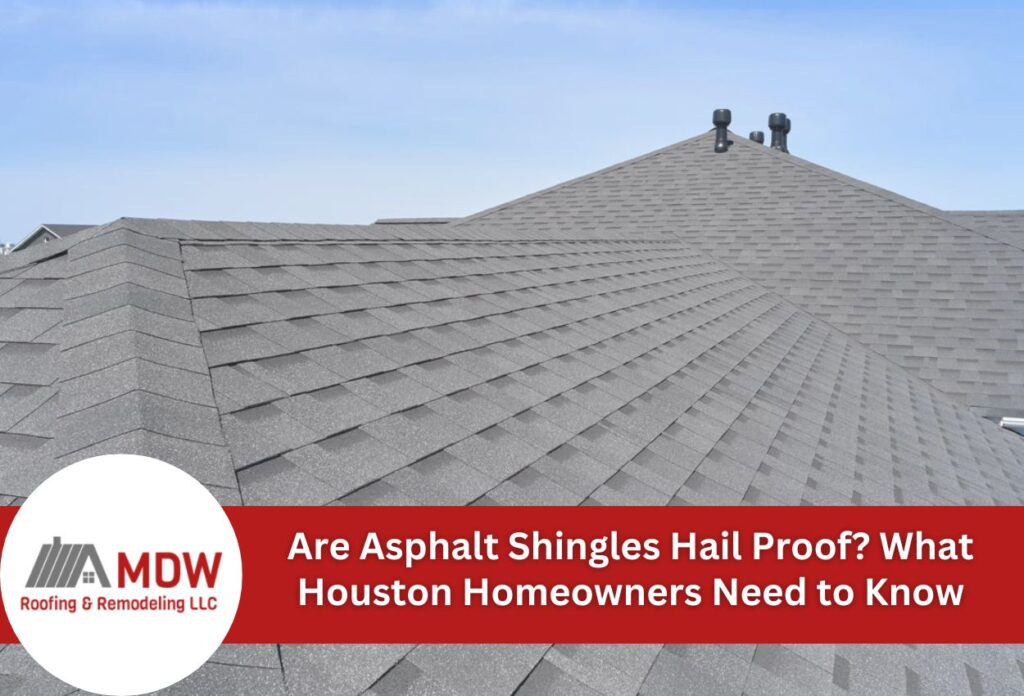

Asphalt shingles are not truly hail-proof, despite what some marketing claims might suggest. This distinction between “hail proof” and “hail resistant” represents an important difference that Houston homeowners must understand when evaluating their roof’s protection against severe weather. No roofing material can guarantee complete immunity from hail damage, especially during the intense storms that regularly sweep through Texas.
The confusion surrounding asphalt shingle hail resistance stems from misunderstandings about what these materials can actually withstand. Standard asphalt shingles offer minimal protection against hail damage, while impact-resistant shingles provide significantly better performance during storms. However, even the most advanced hail-resistant roofing materials have limitations when facing large hailstones or repeated impact.
Houston’s climate presents unique challenges for roofing systems, with hailstorms capable of producing stones ranging from pea-sized pellets to golf ball-sized projectiles. Understanding realistic expectations for shingle resistance helps homeowners make informed decisions about their roofing investments. The key lies in recognizing that while complete hail immunity remains impossible, modern impact-resistant shingles dramatically reduce the likelihood of severe damage compared to traditional materials.
How Hail Damage Actually Affects Asphalt Shingles
Understanding how hail impacts asphalt shingles requires examining the science behind these destructive collisions. When hailstones strike standard asphalt shingles, they create immediate surface damage by displacing granules that protect the underlying mat. This granule loss exposes the asphalt layer to UV radiation and moisture, accelerating deterioration. The force of impact can also crack or fracture the shingle mat itself, creating entry points for leaks.
Different shingle materials respond uniquely to hail impact. Traditional 3-tab shingles are the most vulnerable due to their thinner construction and limited flexibility. Architectural shingles offer slightly better hail damage resistance through their multi-layer design, while impact-resistant shingles incorporate modified asphalt compounds and reinforced backing materials specifically engineered to absorb impact energy.
Visual signs of hail damage include exposed dark spots where granules have been knocked away, creating a speckled appearance across the roof surface. Cracked or split shingles, dented gutters and downspouts, and damaged flashing around roof gaps also indicate potential hail impact.
The size, density, and velocity of hailstones determine the severity of storm damage. Even impact-resistant materials can sustain damage from large hailstones exceeding 2 inches in diameter, emphasizing why no shingle system can claim complete hail immunity.
Understanding Impact Resistance Ratings for Asphalt Shingles
Impact resistance ratings provide the most reliable method for evaluating asphalt shingle hail resistance capabilities. The Underwriters Laboratories (UL) has established 4 distinct classifications, ranging from Class 1 through Class 4, with each level representing progressively better protection against hail damage. Class 1 shingles offer minimal impact protection, withstanding steel balls dropped from specific heights equivalent to small hailstones. Class 2 ratings indicate moderate improvement over basic materials, while Class 3 shingles demonstrate substantial resistance to larger impact forces.
Class 4 impact-resistant shingles represent the highest available rating for residential roofing materials. These premium products must survive repeated strikes from 2-inch steel balls dropped from 12 feet, simulating the impact of golf ball-sized hailstones. The rigorous testing process ensures that Class 4 shingles maintain structural integrity and granule adhesion under severe conditions that would devastate standard materials.
Insurance companies often recognize these ratings through premium discounts for homes with Class 4 hail-resistant roofing materials, acknowledging their superior protection against asphalt shingle storm damage during severe weather events.
Key Factors That Determine Your Asphalt Shingles’ Hail Resistance
Several factors influence how well asphalt shingles withstand hail impact, with shingle age playing the most significant role in vulnerability. As shingles age, their flexibility decreases and granule adhesion weakens, making them increasingly susceptible to hail damage that asphalt shingles experience during storms. Older shingles become brittle and lose their ability to absorb impact energy, causing them to crack or split more easily when struck by hailstones.
Installation quality directly affects asphalt shingle hail resistance by determining how securely shingles attach to the roof deck. Improperly installed shingles may lift during high winds, creating weak points that make them more vulnerable to impact damage. Inadequate nailing patterns, incorrect overlap measurements, or poor flashing installation can compromise the entire system’s ability to resist storm forces and hail impact.
Maintenance history significantly impacts how impact-resistant shingles perform during severe weather. Regular roof inspections and quick repairs help preserve the protective granule layer and maintain structural integrity. Neglected maintenance allows small problems to compound, weakening the overall system and reducing its capacity to withstand hail strikes.
Houston’s intense heat and humidity create additional challenges for hail-resistant roofing materials by accelerating damage from thermal expansion cycles. This constant movement gradually loosens granules and can create micro-cracks that make shingles more vulnerable to asphalt shingle storm damage. High temperatures also soften asphalt compounds, potentially making them more susceptible to permanent deformation from hail impact.
Comparing Standard Asphalt Shingles to Impact-Resistant Alternatives
Traditional 3-tab shingles offer the least protection against hail damage that asphalt shingles typically sustain during severe weather events. These basic materials feature a single-layer construction with minimal thickness, making them vulnerable to granule loss and mat cracking from even moderate-sized hailstones. 3-Tab shingles generally carry Class 1 or Class 2 impact ratings, providing limited defense against storm-related damage while maintaining their position as the most economical roofing option.
Architectural shingles demonstrate improved asphalt shingle hail resistance through their multi-dimensional design and thicker construction. The laminated structure creates additional layers that help absorb impact energy more effectively than single-layer alternatives. Many architectural shingles achieve Class 3 ratings, offering homeowners enhanced protection without requiring specialized impact-resistant materials. Their varied thickness across the shingle surface also helps distribute impact forces more evenly.
Specialized impact-resistant shingles incorporate modified asphalt formulas and reinforced backing materials engineered specifically for superior hail protection. These premium products utilize polymer-modified asphalt compounds that maintain flexibility longer and resist cracking from hail impact. The enhanced material composition allows Class 4 impact-resistant shingles to withstand repeated strikes from large hailstones while preserving granule adhesion and structural integrity.
Manufacturing differences between standard and hail-resistant roofing materials extend beyond basic thickness measurements. Impact-resistant alternatives feature specially formulated adhesives, reinforced mat materials, and granule coatings designed to withstand the extreme forces generated during hailstorms, resulting in measurably better performance against asphalt shingle storm damage.
Storm Damage Prevention and Roof Protection Strategies
Protecting asphalt shingles from hail damage requires a comprehensive approach that combines regular maintenance with strategic upgrades to roofing components. Even impact-resistant shingles benefit from proactive care that maintains their protective capabilities throughout their service life. Preventive measures can significantly extend the performance of hail-resistant roofing materials while reducing the likelihood of expensive storm damage repairs.
Regular roof inspections can be an effective storm damage prevention measure. Professional evaluations identify loose or damaged shingles before they become vulnerable points during hailstorms. Addressing minor issues like lifted shingle corners, loose granules, or damaged flashing prevents these problems from compromising the entire system’s asphalt shingle hail resistance capabilities.
Gutter maintenance plays an important role in protecting the roof’s edge from hail damage that asphalt shingles experience during severe weather. Clogged gutters create water backup that can loosen shingles along the roofline, making them more susceptible to wind uplift and hail impact. Clean, properly functioning gutters help maintain the structural integrity of edge shingles and prevent water infiltration that weakens the roof system.
Tree trimming around the property reduces multiple storm-related risks, including falling branches that can damage shingles before or during hailstorms. Overhanging limbs can scrape across the surface of the roof during high winds, displacing granules and creating weak spots that make shingles more vulnerable to hail strikes. Tree management preserves both the immediate protection and long-term durability of impact-resistant shingles while reducing overall asphalt shingle storm damage potential.
Making the Right Roofing Decision for Houston’s Hail-Prone Climate
Homeowners facing hail damage to existing asphalt shingles must carefully evaluate several factors when deciding between repair and complete replacement. The extent of damage, age of the current roofing system, and frequency of recent storm events all influence this important decision. When hail damage to asphalt shingles shows widespread granule loss, multiple cracked shingles, or compromised structural integrity, replacement is often the more cost-effective option than just doing repairs.
The age of existing shingles significantly impacts the viability of repairs, as older materials become increasingly difficult to match and may not justify the continued investment. Roofing systems approaching or exceeding their expected lifespan should generally receive full replacement rather than temporary fixes. Recent technological advances in asphalt shingle hail resistance make replacement particularly attractive for homes with outdated materials that lack modern impact protection.
Long-term value assessment reveals compelling advantages for investing in higher-rated impact-resistant shingles during replacement projects. Class 4 hail-resistant roofing materials provide measurably better protection against future storm damage while potentially reducing insurance premiums through available discounts. The enhanced durability of impact-resistant shingles extends the lifespan of a roof and reduces the frequency of storm-related repairs, creating substantial savings over time. Modern impact-resistant shingles also maintain better appearance after weather exposure compared to standard materials, preserving property value while providing superior protection against storm damage during Houston’s challenging weather patterns.
Enhance Your Home’s Defense Against Hail with MDW Roofing & Remodeling LLC
If you’re concerned about how hail can affect your roof, it’s important to choose the right materials and professionals for the job. In Houston’s hail-prone climate, opting for impact-resistant shingles can be a wise decision to protect your property. MDW Roofing & Remodeling LLC specializes in providing top-tier roofing solutions that cater to the unique needs of the area. Our team can help you assess your current roofing condition and recommend the best options for hail damage prevention.
Don’t wait until the next storm to find out if your roof is vulnerable. Call us today at (832) 766-9994 and let MDW Roofing & Remodeling LLC help you make an informed decision about your roofing materials and ensure your home is prepared for whatever the weather throws at it.