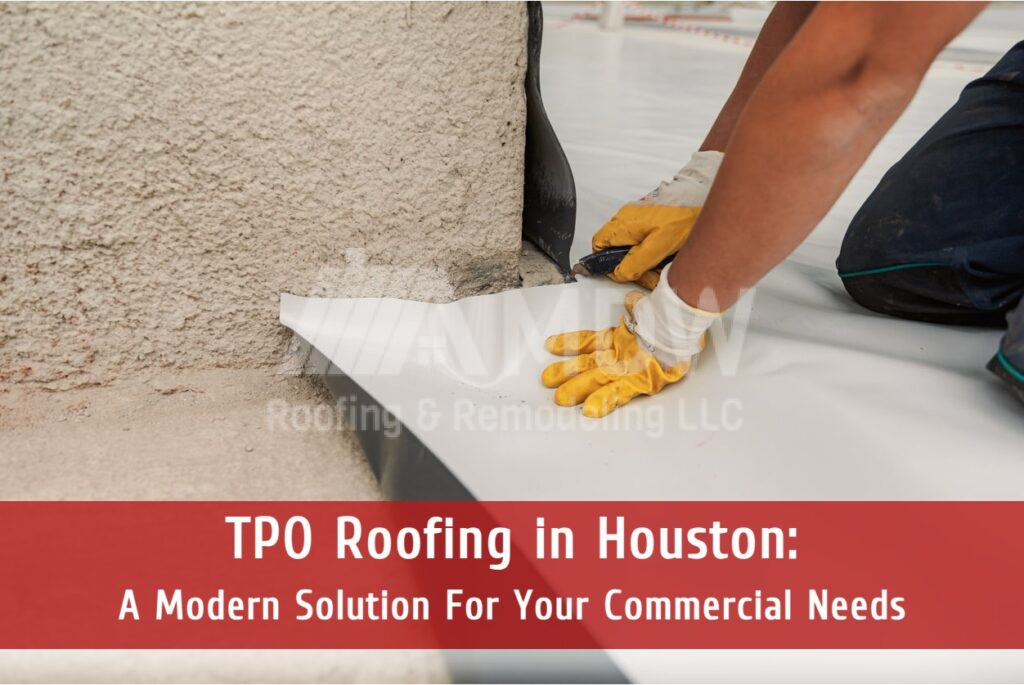
TPO roofing in Houston provides commercial buildings energy-efficient, durable membrane systems reducing cooling costs 15-30% through highly reflective white surfaces (80-85% solar reflectance) particularly valuable in Houston’s subtropical climate averaging 95°F+ temperatures 100+ days annually. Thermoplastic Polyolefin (TPO) membranes—composed of polypropylene and ethylene-propylene rubber blends—offer 20-25 year lifespans when properly installed and maintained, costing $4-$8 per square foot installed ($16,000-$32,000 typical 4,000 sq ft commercial roof) compared to $6-$10/sq ft PVC or $3-$6/sq ft modified bitumen alternatives.
TPO installation methods include mechanically-attached systems ($4-$6/sq ft using plates and fasteners through membrane into deck providing flexibility for building movement), fully-adhered applications ($6-$8/sq ft bonding membrane directly to substrate maximizing wind uplift resistance critical for Houston’s hurricane exposure), and ballasted installations (limited applications using stone/pavers holding membrane in place at $5-$7/sq ft). Heat-welded seams—created using hot-air welding equipment bonding overlapping membrane sections—provide superior waterproofing versus adhesive or tape-sealed joints, critical for protecting against Houston’s 53 inches annual rainfall and intense 4-8 inch per hour storm events.
Houston’s challenging climate—featuring sustained summer heat stressing membrane flexibility, 70-90% humidity fostering biological growth on poorly maintained surfaces, hurricane-force winds (130+ mph during major storms) testing mechanical attachment integrity, and ultraviolet radiation degrading inferior formulations—demands proper TPO material selection, installation technique, and preventive maintenance maximizing system performance and longevity. This comprehensive guide details TPO composition and manufacturing, performance characteristics in Houston’s climate, installation methodology comparison, cost analysis versus alternative systems, maintenance protocols extending lifespan, and contractor selection criteria ensuring quality installations meeting manufacturer warranty requirements while delivering expected energy savings and durability.
Understanding TPO Roofing Material Composition
TPO (Thermoplastic Polyolefin) represents a single-ply roofing membrane manufactured from polypropylene and ethylene-propylene rubber polymers formulated to provide flexibility, UV resistance, and thermal stability essential for commercial flat and low-slope roof applications. Unlike thermoset membranes such as EPDM requiring adhesive-bonded seams, TPO’s thermoplastic nature allows heat welding creating monolithic waterproof barriers superior to mechanically or chemically fastened alternatives.
TPO formulation components:
- Base polymer blend – Polypropylene provides rigidity and dimensional stability while ethylene-propylene rubber contributes flexibility and low-temperature performance
- UV stabilizers – Hindered amine light stabilizers (HALS) and other additives protect polymer chains from ultraviolet degradation extending membrane lifespan
- Flame retardants – Chemical additives meeting building code fire ratings (typically Class A UL 790)
- Plasticizers – Compounds maintaining flexibility across temperature ranges (-40°F to 180°F+)
- Reinforcement scrim – Polyester or fiberglass fabric embedded within membrane providing tensile strength and dimensional stability
- Biocides – Antimicrobial agents preventing algae and mold growth particularly important in humid climates
Modern TPO formulations have evolved significantly since initial 1990s introductions when early products experienced premature failures from inadequate UV stabilization and plasticizer migration. Contemporary third-generation TPO membranes from established manufacturers demonstrate 15-25+ year performance histories validating improved formulations, though quality variations persist across brands emphasizing importance of specifying proven products from reputable suppliers.
TPO Performance in Houston’s Climate
Houston’s subtropical humid climate (Köppen classification Cfa) creates demanding roofing conditions combining intense solar radiation, high humidity, heavy precipitation, and periodic severe weather requiring membrane systems demonstrating comprehensive performance across multiple stress factors rather than single-attribute optimization.
Climate challenge factors:
| Climate Factor | Houston Characteristics | TPO Performance Response | Competitive Advantage |
|---|---|---|---|
| Solar radiation | 95°F+ temperatures 100+ days, 1,600-1,800 annual sunshine hours | 80-85% solar reflectance, minimal heat absorption | Outperforms dark EPDM (10-15% reflectance), matches PVC |
| Thermal cycling | 30-40°F daily temperature swings, 20-100°F seasonal range | Maintains flexibility -40°F to 180°F+, resists cracking | Better low-temp performance than modified bitumen |
| Humidity exposure | 70-90% relative humidity year-round | Inherently mold/mildew resistant surface | Superior to organic-based modified bitumen |
| Heavy rainfall | 53 inches annual average, 4-8 inch intensity storms | Heat-welded seams 3-5× stronger than adhesive bonds | Exceeds mechanical fastening, matches fully-adhered PVC |
| Hurricane winds | 130+ mph sustained during major storms | Mechanically-attached: adequate; Fully-adhered: excellent | Fully-adhered TPO equals PVC wind resistance |
| UV degradation | Year-round intense sunlight exposure | Modern stabilizers prevent chalking 15-20+ years | Third-generation formulations match PVC longevity |
The National Roofing Contractors Association emphasizes that material selection must align with regional climate challenges, with TPO representing optimal balance of reflectivity, durability, and cost-effectiveness for hot humid climates like Houston where cooling loads dominate energy consumption and membrane flexibility prevents thermal stress cracking common in less engineered alternatives.
Energy Efficiency and Cost Savings
TPO’s primary value proposition for Houston commercial buildings centers on cooling cost reduction through solar heat rejection—white membrane surfaces reflect 80-85% of incident solar radiation versus 10-30% for conventional dark-colored roofing preventing 50-80°F surface temperature increases that transfer heat into building interiors requiring additional air conditioning capacity.
Energy performance metrics:
- Surface temperature reduction – TPO roofs maintain 100-120°F peak temperatures versus 160-180°F for dark membranes (40-60°F cooler)
- Cooling load reduction – 15-30% air conditioning energy savings typical in Houston climate depending on building insulation and HVAC efficiency
- Peak demand reduction – Lower afternoon temperatures reduce electrical demand charges (significant for commercial rate structures)
- LEED contribution – Cool roof credits supporting green building certification requirements increasingly common in commercial development
- Urban heat island mitigation – Reflective surfaces reduce ambient temperatures benefiting surrounding community
A typical 20,000 square foot Houston office building consuming $30,000 annually in cooling costs realizes $4,500-$9,000 annual savings from TPO installation versus conventional roofing—savings of $90,000-$180,000 over 20-year membrane lifespan significantly exceeding initial installation premium over lowest-cost alternatives. The Department of Energy Cool Roof Calculator provides building-specific analysis accounting for local climate data, building characteristics, and utility rates validating energy savings projections before material selection.
TPO Installation Methods Comparison
TPO membranes accommodate three primary installation methods—mechanically-attached, fully-adhered, and ballasted—each offering distinct performance characteristics, cost implications, and suitability for specific roof configurations and performance requirements. Installation method selection significantly impacts wind uplift resistance, thermal movement accommodation, and total installed cost.
Mechanically-Attached TPO Installation
Mechanically-attached systems secure TPO membrane to roof deck using plates and fasteners penetrating through membrane into structural deck at prescribed spacing patterns, with overlapping membrane edges heat-welded creating continuous waterproof barrier. This method represents most common TPO installation approach due to lower material costs, faster installation, and minimal adhesive requirements.
Mechanical attachment characteristics:
| Aspect | Details | Cost Impact | Performance Consideration |
|---|---|---|---|
| Fastener spacing | 12-24 inch centers typical, closer spacing for higher wind zones | Denser patterns increase labor 15-25% | Houston hurricane exposure requires engineered spacing |
| Plate types | Steel or plastic stress plates distribute fastener loads | Plastic plates: +$0.25-$0.50/sq ft versus steel | Plastic reduces thermal bridging, corrosion |
| Membrane thickness | 45-80 mil (0.045-0.080 inch) with thicker providing better puncture resistance | 60 mil standard costs ~$4/sq ft; 80 mil premium ~$5.50/sq ft | Thicker membranes justify expense for high-traffic roofs |
| Insulation attachment | Separate fasteners secure insulation below membrane | Adds $0.50-$1.00/sq ft versus fully-adhered integrated systems | Two-part attachment provides thermal performance flexibility |
| Wind uplift ratings | UL 580 Class 30-90 achievable depending on fastener density | Higher ratings require denser fastening (+$0.50-$1.50/sq ft) | Houston coastal areas may require Class 60+ |
| Installation speed | 2,000-3,000 sq ft per day per crew typical | Labor efficiency reduces total cost | Weather delays less impactful than adhesive installations |
Mechanically-attached installations cost $4-$6 per square foot installed in Houston market including membrane, insulation, fasteners, and labor—representing most economical TPO approach suitable for many applications though providing lower wind resistance than fully-adhered alternatives. The system’s inherent flexibility accommodates building movement and thermal expansion without membrane stress, advantageous for structures experiencing foundation settlement or significant thermal cycling.
Fully-Adhered TPO Installation
Fully-adhered systems bond TPO membrane directly to substrate using specialized adhesives applied to both membrane underside and prepared deck surface, creating continuous attachment across entire roof area. While more expensive and weather-dependent during installation, fully-adhered systems provide superior wind uplift resistance and accommodate aesthetic preferences avoiding visible fastener patterns.
Fully-adhered system characteristics:
- Adhesive types – Low-VOC water-based, solvent-based, or two-part urethane formulations with varying open times and bond strength
- Application methods – Roller, brush, or spray application with coverage rates 40-100 sq ft per gallon depending on substrate porosity
- Substrate requirements – Smooth, clean, dry surfaces essential for proper adhesion; rough or contaminated decks require additional preparation
- Wind resistance – UL 580 Class 90-270 achievable with proper installation, significantly exceeding mechanical attachment
- Installation constraints – Temperature restrictions (typically 40°F+ ambient and substrate), humidity limitations, and precipitation sensitivity
- Cost premium – $6-$8 per square foot installed ($2-3/sq ft premium versus mechanical attachment) due to adhesive cost and labor intensity
Houston’s hurricane exposure often justifies fully-adhered installation premium for buildings in coastal areas or where catastrophic loss prevention outweighs cost considerations. Buildings in Harris County evacuation zones or near Galveston Bay particularly benefit from enhanced wind performance reducing insurance premiums and business interruption risks.
Installation Method Selection Criteria
Choosing between mechanical attachment and fully-adhered installation requires evaluating multiple factors including building location, wind exposure, roof configuration, budget constraints, and performance priorities.
Decision framework:
- Wind exposure – Coastal locations within 10 miles of Gulf Coast favor fully-adhered; inland locations adequate for mechanical attachment
- Roof height – Buildings >60 feet elevation experience higher wind pressures warranting fully-adhered installation
- Building importance – Critical facilities (hospitals, emergency operations centers) justify fully-adhered despite cost premium
- Budget constraints – Mechanical attachment provides 25-40% cost savings for budget-limited projects
- Deck condition – Rough or uneven decks poorly suited for adhesive requiring mechanical attachment
- Aesthetic concerns – Visible fastener patterns objectionable to some owners favoring fully-adhered appearance
Professional roof inspections and engineering analysis determine appropriate installation method balancing performance requirements against budget realities and building-specific conditions.
TPO Cost Analysis and Budget Planning
Understanding complete TPO roofing system costs—including material, installation, ancillary components, and long-term maintenance—enables accurate budget planning and informed comparison against alternative membrane systems. Installed costs vary significantly based on project size, roof complexity, installation method, and regional labor rates.
Complete System Cost Breakdown
| Cost Component | Mechanically-Attached Range | Fully-Adhered Range | Notes |
|---|---|---|---|
| TPO membrane (60 mil) | $1.50-$2.50/sq ft | $1.50-$2.50/sq ft | Premium brands command 20-30% premium over value options |
| Polyiso insulation (R-20) | $1.25-$2.00/sq ft | $1.25-$2.00/sq ft | Thickness/R-value directly impact cost; building codes require minimum R-10 to R-20 |
| Cover board (1/2″ gypsum or cement) | $0.50-$0.90/sq ft | $0.50-$0.90/sq ft | Protects insulation, enhances puncture resistance, fire rating |
| Fasteners and plates | $0.40-$0.80/sq ft | N/A | Quantity depends on wind zone and spacing requirements |
| Adhesive | N/A | $0.75-$1.50/sq ft | Coverage rates vary by substrate and adhesive type |
| Labor installation | $1.50-$2.50/sq ft | $2.50-$3.50/sq ft | Complexity, access, and crew efficiency affect rates |
| Tear-off/disposal (if required) | $1.00-$2.00/sq ft | $1.00-$2.00/sq ft | Existing roof removal adds significant cost; recover-over reduces this |
| Flashing and penetrations | $0.50-$1.00/sq ft | $0.50-$1.00/sq ft | Complexity varies by HVAC units, vents, drains, parapet walls |
| Project management/overhead | $0.50-$1.00/sq ft | $0.50-$1.00/sq ft | Contractor markup covering supervision, insurance, profit |
| Total installed cost | $7.15-$13.70/sq ft | $8.50-$15.40/sq ft | Typical ranges: Mechanical $4-$6/sq ft; Fully-adhered $6-$8/sq ft for straightforward projects |
A typical 4,000 square foot Houston commercial building requiring complete TPO roof replacement costs $16,000-$32,000 installed depending on installation method, insulation thickness, and project complexity. Larger buildings (10,000+ square feet) achieve economies of scale reducing per-square-foot costs 15-25% through mobilization efficiency and material volume discounts.
Lifecycle Cost Comparison
Comparing TPO against alternative commercial roofing systems requires evaluating total cost of ownership over expected service life—including initial installation, maintenance expenses, energy savings, and replacement timing—rather than installation cost alone.
20-year lifecycle cost analysis (4,000 sq ft building):
| System Type | Initial Install | Maintenance (20 years) | Energy Cost Difference | Total 20-Year Cost | Cost Per Year |
|---|---|---|---|---|---|
| TPO (mechanically-attached) | $18,000 | $2,000 | Baseline | $20,000 | $1,000 |
| TPO (fully-adhered) | $26,000 | $2,000 | Baseline | $28,000 | $1,400 |
| PVC | $32,000 | $2,500 | Baseline | $34,500 | $1,725 |
| Modified bitumen | $14,000 | $4,000 | +$6,000 (higher cooling costs) | $24,000 | $1,200 |
| EPDM | $12,000 | $3,000 | +$8,000 (higher cooling costs) | $23,000 | $1,150 |
Lifecycle analysis demonstrates mechanically-attached TPO providing lowest total ownership cost for Houston commercial buildings when installation quality ensures 20+ year lifespan. Fully-adhered TPO justifies premium in high-wind coastal locations where enhanced performance prevents catastrophic loss exceeding incremental cost. Modified bitumen and EPDM systems, while offering lower installation costs, incur higher energy expenses over time reducing apparent savings.
TPO Maintenance Requirements and Schedules
Proper maintenance extends TPO membrane lifespan from typical 15-20 years to potential 25-30 years, maximizing return on installation investment while preventing premature failures voiding manufacturer warranties. Houston’s climate demands particular attention to debris removal, drainage maintenance, and seam integrity verification.
Recommended Maintenance Schedule
| Maintenance Task | Frequency | Typical Cost | Critical Importance | Houston Climate Rationale |
|---|---|---|---|---|
| Professional inspection | Semi-annual (April, October) | $200-$400 per visit | High | Pre/post hurricane season verification; identify storm damage |
| Debris removal | Quarterly minimum | $150-$300 per service | High | Heavy storms deposit branches, leaves creating puncture/drainage risks |
| Drain cleaning | Quarterly minimum | $200-$400 per service | Critical | 53″ annual rainfall requires unobstructed drainage preventing ponding |
| Seam inspection | Annual | Included in professional inspection | High | Heat/UV stress seams over time; early detection prevents leaks |
| Puncture/damage repair | As needed | $150-$500 per repair | Critical | Prompt repair prevents water infiltration and progressive damage |
| Surface cleaning | Annual or as needed | $0.25-$0.75/sq ft | Medium | Maintains reflectivity and prevents biological growth |
| Warranty documentation | Per warranty terms | No cost (internal) | Medium | Photographic records demonstrate compliance with warranty terms |
The National Roofing Contractors Association recommends semi-annual inspections timed before and after severe weather seasons, with Houston’s hurricane exposure (June-November) justifying April pre-season and October post-season timing. Inspections should document membrane condition, seam integrity, flashing details, drainage function, and any damage requiring repair before minor issues progress to major failures.
Common TPO Problems and Solutions
Understanding typical TPO issues and appropriate remediation enables proactive maintenance preventing minor problems escalating into expensive failures or complete system replacement.
Maintenance issue resolution:
- Ponding water – Standing water remaining 48+ hours after rainfall indicates inadequate drainage from deflected deck, clogged drains, or original design deficiency (solution: improve drainage, install additional drains, or accept/monitor if shallow <1 inch)
- Shrinkage at perimeters – TPO membranes contract slightly over time potentially pulling away from flashing or perimeter attachments (solution: install additional fasteners or flashing restraints maintaining contact)
- Foot traffic damage – Excessive HVAC maintenance traffic creates wear patterns or punctures particularly at equipment areas (solution: install walk pads or pavers protecting high-traffic zones)
- Biological growth – Algae or mold growth on membrane surface in shaded areas or where debris accumulates (solution: surface cleaning with approved cleaners; avoid pressure washing damaging membrane)
- Seam separation – Heat-welded seams occasionally delaminate from installation defects or material incompatibility (solution: cut out damaged section, install patch with proper heat welding technique)
- Punctures from debris – Storm-blown branches or wind-lifted equipment create small holes allowing water entry (solution: clean area, apply TPO patch material with proper heat welding or adhesive bonding)
Most TPO repairs cost $150-$500 for minor punctures or small seam sections, far less than progressive water damage causing insulation saturation, deck deterioration, or interior damage totaling $2,000-$10,000+. Prompt attention to maintenance issues protects roof investment and prevents warranty voidance from neglect.
TPO Versus Alternative Commercial Roofing Systems
Houston commercial building owners choosing between TPO and alternative membrane systems should evaluate multiple performance factors, cost implications, and building-specific requirements rather than defaulting to lowest-cost options that may underperform in local climate conditions.
Material Performance Comparison
| Material | Typical Cost (installed) | Expected Lifespan (Houston) | Energy Efficiency | Wind Resistance | Chemical Resistance | Best Applications |
|---|---|---|---|---|---|---|
| TPO | $4-$8/sq ft | 20-25 years | Excellent (80-85% reflectance) | Good-Excellent (method dependent) | Good | General commercial, warehouses, retail, offices |
| PVC | $6-$10/sq ft | 20-30 years | Excellent (80-85% reflectance) | Excellent | Excellent | Restaurants, chemical facilities, high-wind coastal areas |
| EPDM | $3-$6/sq ft | 15-25 years | Poor-Fair (black: 10-15% reflectance; white: 70-75%) | Good | Excellent | Budget projects, non-cooled buildings, northern climates |
| Modified bitumen | $3-$6/sq ft | 12-20 years | Fair (60-70% reflectance white cap sheet) | Good | Fair | Budget projects, moderate climate exposure |
| Built-up (BUR) | $4-$7/sq ft | 15-25 years | Poor-Fair | Good | Fair | Heavy foot traffic, industrial applications |
| Spray polyurethane foam (SPF) | $5-$8/sq ft | 20-30+ years | Excellent (insulation + reflective coating) | Excellent | Fair | Re-roofing, complex shapes, high insulation requirements |
TPO’s combination of reflectivity, durability, and moderate cost makes it optimal default choice for most Houston commercial applications. PVC roofing justifies premium cost for restaurants (grease resistance), coastal buildings (superior wind performance), or facilities handling chemicals requiring enhanced membrane resistance. EPDM and modified bitumen systems serve budget-constrained projects accepting higher energy costs and reduced lifespans.
When to Consider Alternative Systems
While TPO suits most Houston commercial roofing applications, specific building characteristics or performance requirements may favor alternative systems delivering superior value despite different cost structures.
Alternative system triggers:
- PVC preferred – Restaurants or food service facilities where grease exposure threatens TPO; coastal locations requiring maximum wind resistance; buildings handling chemicals incompatible with TPO; owners prioritizing absolute maximum lifespan despite cost premium
- EPDM preferred – Unconditioned warehouses or storage buildings where reflectivity provides limited benefit; budget-constrained projects accepting shorter lifespans; buildings in protected inland locations with minimal wind exposure
- Modified bitumen preferred – Heavy foot traffic applications where membrane flexibility and self-healing properties prevent damage; owners familiar with built-up roofing preferring similar installation and maintenance
- SPF preferred – Re-roofing projects avoiding tear-off expenses; buildings requiring very high insulation R-values; complex roof shapes with numerous penetrations difficult for single-ply membrane detailing
Professional roofing contractors evaluate building-specific requirements, budget constraints, and performance priorities recommending optimal system balancing competing factors rather than defaulting to single preferred material regardless of application suitability.
Contractor Selection and Quality Assurance
TPO installation quality critically determines long-term performance—even premium materials fail prematurely when installed improperly, while proper installation of mid-grade products often outperforms poor installation of premium materials. Selecting experienced, qualified contractors ensures installation meeting manufacturer specifications and warranty requirements.
Essential Contractor Qualifications
Minimum contractor requirements:
- Manufacturer certification – Current certification from TPO manufacturer being installed (Carlisle, GAF, Firestone, Johns Manville, etc.) demonstrating training and quality standards compliance
- Licensing and insurance – Valid Texas contractor license, minimum $2 million general liability coverage, workers compensation for all crew members
- Experience verification – Minimum 5+ years commercial TPO installation experience in Houston area understanding local climate challenges
- References and portfolio – Recent similar projects with verifiable references demonstrating quality work and customer satisfaction
- Warranty offerings – Ability to offer manufacturer system warranties (10-30 years) requiring approved contractor status and proper installation documentation
- Safety programs – Written safety procedures, OSHA compliance, fall protection equipment for crew protection
- Financial stability – Established business with track record ensuring contractor remains available for warranty service throughout coverage period
The National Roofing Contractors Association maintains contractor directories searchable by location and specialization, while manufacturers provide lists of certified contractors meeting their quality standards. Obtaining three competitive bids from qualified contractors enables cost comparison while ensuring selection from competent professionals rather than lowest-bidding unqualified operators.
Quality Installation Verification
Building owners should verify proper installation procedures during construction and completion, with manufacturer representatives often providing third-party inspection services validating compliance with system specifications required for warranty coverage.
Critical installation checkpoints:
- Substrate preparation – Clean, dry, smooth deck surfaces suitable for membrane application; proper fastener spacing and pull-through resistance verification
- Insulation installation – Proper attachment, staggered joints, tight fitting between boards preventing thermal bridging and moisture infiltration
- Membrane placement – Correct orientation, appropriate overlaps (minimum 3 inches typical), wrinkle-free installation allowing for thermal movement
- Seam welding – Proper temperature (900-1,100°F typical), overlap pressure, continuous fusion verified by visual inspection and destructive testing
- Flashing details – Proper terminations at walls, penetrations, drains, and edges following manufacturer details preventing water entry points
- Drainage verification – Positive slope to all drains, no ponding areas, properly sealed drain assemblies preventing leaks
Quality contractors welcome owner observation and third-party inspection, recognizing proper installation protects their reputation while ensuring customer satisfaction. Contractors resisting oversight or refusing manufacturer inspection should be avoided regardless of cost savings claimed.
TPO Warranty Considerations
Understanding TPO warranty coverage, exclusions, and maintenance requirements prevents surprises when issues arise and ensures maximum manufacturer support throughout roof lifespan. TPO warranties typically include material defect coverage from manufacturer and workmanship coverage from installing contractor, with terms and limitations varying significantly between offerings.
Warranty Coverage Types
Standard warranty options:
- Material-only warranty (10-20 years) – Manufacturer covers TPO membrane defects; contractor provides separate workmanship warranty (typically 1-5 years); most economical option though splitting coverage complicates claims
- System warranty (15-30 years) – Manufacturer warrants complete roofing system including insulation, cover board, flashing details when installed by certified contractor using approved materials; single-source coverage simplifies claims
- No-dollar-limit (NDL) warranty – Premium coverage providing full replacement cost without depreciation or maximum limits; most comprehensive protection though requiring premium materials and installation
- Workmanship warranty (1-10 years) – Contractor-provided coverage for installation defects; length varies by contractor reputation and project scope
Houston’s climate stress warrants system warranty consideration—comprehensive coverage prevents disputes over whether leaks stem from material defects or installation errors, with manufacturer backing entire system when approved contractors follow specifications.
Warranty Maintenance Requirements
All TPO warranties contain maintenance clauses requiring periodic inspections, documented repairs, and proper upkeep as conditions for continued coverage. Failure to maintain roofs per warranty terms voids coverage, leaving owners financially responsible for all repairs regardless of underlying cause.
Typical warranty maintenance obligations:
- Semi-annual professional inspections documenting roof condition with photographic records
- Prompt repair of damage (typically within 30-60 days of discovery) preventing progressive deterioration
- Debris removal and drain cleaning maintaining proper drainage and preventing ponding
- Prohibition on unauthorized modifications or repairs by non-certified contractors
- Notification to manufacturer of significant building changes affecting roof loads or conditions
Maintaining comprehensive maintenance records including inspection reports, repair invoices, cleaning documentation, and photographic evidence demonstrates warranty compliance should coverage disputes arise. The relatively modest maintenance investment ($500-$1,500 annually typical for small-to-medium commercial buildings) protects $20,000-$50,000+ roof investments and ensures warranty coverage remains valid throughout term.
Taking Action on TPO Roofing Projects
Houston commercial building owners evaluating TPO roofing—whether for new construction, replacement of failed systems, or proactive upgrades from aging roofs—benefit from systematic decision-making processes balancing performance requirements, budget constraints, and long-term value considerations rather than reflexively accepting lowest-cost proposals that may underperform in local climate conditions.
The strategic advantages TPO offers Houston commercial properties—15-30% cooling cost reductions generating $3,000-$10,000+ annual savings for typical buildings, 20-25 year lifespans minimizing re-roofing frequency, heat-welded seam integrity preventing costly water damage and business interruption, and proven durability in hot humid climates similar to Houston—justify material and installation investments despite availability of cheaper alternatives providing inferior performance and higher lifecycle costs.
Successful TPO projects require three critical elements: proper material selection from reputable manufacturers with proven third-generation formulations avoiding early TPO reliability issues, qualified installation by certified contractors following manufacturer specifications ensuring warranty coverage validity, and commitment to preventive maintenance protocols documenting semi-annual inspections and prompt repairs protecting physical assets while preserving warranty rights. The relatively minor incremental costs for quality materials, professional installation, and routine maintenance ($1,000-$3,000 annually typical) pale compared to consequences of premature roof failure including $10,000-$50,000+ replacement costs, business interruption losses, interior damage expenses, and potential liability exposures from water-damaged building spaces.
Building owners recognizing signs that current roofs approach end of useful life—excessive repairs consuming $1,000+ annually, visible membrane deterioration including cracks or splits, recurring leaks resistant to patching, energy bills increasing despite stable usage, or roofs approaching 20+ years age—should schedule professional assessments determining whether continued repairs or complete replacement provides better economic value. In many cases, proactive replacement before catastrophic failure enables orderly planning, competitive contractor selection, and scheduling avoiding emergency premiums and business disruption inherent in reactive crisis response.
For professional evaluation of commercial roofing needs, TPO system design and installation, or existing roof assessment in Houston and surrounding areas, contact MDW Roofing & Remodeling.